Published
The EU–Mercosur Agreement Is Not Old. The Debate About It Is.
By: Bruno Capuzzi
Research Areas: EU Single Market, Institutions, and Governance EU-Mercosur Project Latin America Regions Trade, Globalisation and Security
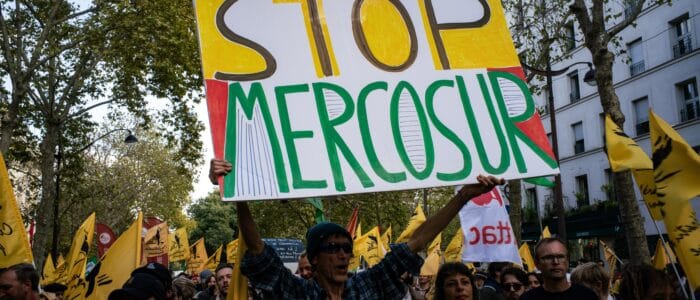
Much of the opposition to the EU–Mercosur agreement relies on claims that do not stand up to scrutiny. The agreement is often portrayed as outdated, a threat to agriculture, and environmentally regressive. These critiques are rarely evidenced, and a closer look at the text and the numbers points in the opposite direction. What appears outdated is not the agreement itself, but a debate that repeatedly returns to the same narratives without engaging with evidence.
Critics often argue that negotiations started twenty-five years ago and therefore reflect an obsolete economic model centred on exporting cars in exchange for cows. Others claim the agreement would flood the EU market with cheap agricultural products produced under lower environmental and social standards.
These arguments are politically effective, but analytically weak. They misrepresent how the negotiations evolved, what the agreement contains, and how EU agricultural markets are actually protected. They also overlook that the agreement is not a pure free trade arrangement. Many barriers remain. Rather, it is a framework for stability, predictability, and cooperation. It is a political statement allowing thirty-one countries and more than seven hundred million people to interact and agree on rules, procedures, and legal commitments. In the current international context, this matters both for the agreement’s endorsement of international public law and support for trade.
Negotiations Did Not Last Twenty-Five Years
It is true that EU–Mercosur negotiations were launched in 1999. It is not true that they were negotiated continuously for twenty-five years. The process was marked by long periods of stagnation and political disengagement. Entire negotiation rounds collapsed and were followed by years of inactivity, often due to fundamental disagreements on market access for agriculture and industry.
The agreement that has now been concluded is not a refurbished text from 1999. It incorporates chapters and language that did not exist at the time, including provisions on e-commerce and sustainable development. Human rights and environmental protection are defined as essential elements, with explicit references to the Paris Agreement. Should a Mercosur partner withdraw from the Paris Agreement, EU concessions under the deal could be suspended. This is not the architecture of an outdated trade agreement.
The Outdated Narrative of Cows and Cars
Describing the agreement as an exchange of European cars for Mercosur cows oversimplifies the economic relationship between the two blocs. It assumes European competitiveness lies exclusively in industry and Mercosur’s in agriculture, while ignoring deep complementarities across value chains.
European agriculture itself depends heavily on imported inputs. For certain commodities, import dependency can reach up to sixty-six per cent. Today, around seventy-two per cent of EU imports from Mercosur, by value, already enter the EU at zero tariffs. Almost half of these imports concern goods for which the EU is structurally dependent on external supply, such as soybeans, coffee, crude oil, and pulp. These flows are not marginal, nor are they created by the agreement. They already exist.
Politically sensitive agricultural sectors remain among the most protected in the EU. Beef, poultry, ethanol, sugar, maize, and rice are subject to strict tariff rate quotas. These quotas represent a very small share of EU consumption and are designed precisely to limit market exposure.
Even within these sensitive sectors, Mercosur imports often play a complementary role. Poultry is a clear example. By total production numbers, the EU would be self-sufficient. It depends, however, on imported chicken breasts to meet the demand for more expensive cuts. In practice, the EU exports lower-value cuts such as wings and feet while importing breasts to match consumption patterns. Without trade, producers would have to use leftovers, and consumer demand would be unmet. Since the poultry quota under the agreement is below current import levels, it is unlikely to trigger additional demand or an import surge.
Cheap Products and Floods of Imports
The claim that Mercosur agriculture is cheap and therefore threatening EU farmers is not supported by data. EU imports of beef and poultry from Mercosur are consistently registered at prices above the EU market average.
For sugar, the argument is also misleading. The quota offered to Brazil under the agreement replaces an existing WTO quota under which Brazilian sugar already enters the EU at zero tariff. In practical terms, this does not expand market access.
Opposition to the agreement, therefore, appears driven more by political economy dynamics within the Common Agricultural Policy. The Partnership Agreement has become a proxy battlefield for domestic distributional conflicts rather than a reflection of actual import pressure. The idea of sudden floods of imports ignores both quota design and existing trade patterns.
Production Standards and Regulatory Framework
Another recurrent argument is that Mercosur agriculture is inherently unsustainable and operates under lower environmental standards. Calls for broad reciprocity through so-called mirror clauses have gained traction within civil society. This claim requires a comparison of regulatory systems, not slogans.
As shown by Emily Rees in an ECIPE study on the application of mirror clauses to pesticides,[1] demanding identical production practices across countries is neither economically sound nor environmentally effective. Agricultural conditions differ structurally across regions due to climate, pest pressure, soil composition, and disease prevalence. Requiring exporters to replicate EU-specific practices, rather than meet equivalent outcomes, risks imposing high compliance costs without clear environmental gains. As the study notes, the same input may pose very different risks depending on local conditions. Mirror clauses based on process replication, rather than risk-based assessment, may lead to trade barriers that penalise efficient and sustainable producers without necessarily improving consumer or environmental protection. Regulatory divergence often reflects agronomic reality rather than weaker standards.
Brazil’s Forest Code illustrates this point. Despite well-known implementation challenges, it is one of the most comprehensive environmental land-use laws in the world. It mandates the protection of permanent preservation areas, legal reserves, and biodiversity on private landholdings. Depending on the ecosystem, landowners must conserve between twenty and eighty per cent of native vegetation on their land. Cultivation is also prohibited near rivers and water flows, even in private properties, with distances varying by farm size. If these location-specific requirements were mechanically applied to imports, many European producers would be unable to export to Brazil.
Crucially, the Forest Code is underpinned by the Rural Environmental Registry (CAR), a nationwide geospatial system linking land ownership, environmental obligations, and enforcement. CAR has become central to environmental compliance, monitoring, and increasingly supply-chain due diligence. Few EU member states operate a comparable system at similar scale. A Climate Policy Initiative report documents both the progress and remaining challenges in its implementation.[2]
Deforestation and Its Drivers
Concerns about deforestation are legitimate, but they are often misplaced in the context of this agreement. The commodities most commonly associated with deforestation are soybeans and beef. The EU already depends on imports for around seventy per cent of its animal feed needs and applies zero tariffs on soybeans. That sector is already liberalised.
Beef concessions under the agreement are capped at ninety-nine thousand tonnes under reduced tariffs. Roughly half of what the EU imports from Mercosur, it presents less than two per cent of EU consumption and less than 1 per cent of Mercosur production. Bound by quotas, the incremental trade effects are too limited to generate meaningful land-use change. A new quota does not create incentives for Europeans to consume more beef than they already import from Mercosur, as elegantly demonstrated by Prof Alan Matthews.[3]
Beyond market logic, regulatory constraints further limit any import surge. Slaughterhouses must be individually approved to export to the EU. In Brazil’s case, only around one fifth of facilities are authorised, creating a hard supply ceiling irrespective of tariff preferences.
Moving the Needle
The EU–Mercosur agreement deserves scrutiny, but it also requires analytical sincerity. It is neither a reckless opening of EU agriculture nor an endorsement of environmental neglect. A serious debate on trade and sustainability must engage with institutions and evidence rather than slogans.
The agreement’s political dialogue and cooperation pillar provides a framework to do precisely that. Through scheduled exchanges and formal mechanisms at both political and technical levels, the European Union and Mercosur countries can pursue regulatory cooperation and alignment over time. A more effective governance strategy, rather than relying on unilateral measures.
Recent setbacks in EU environmental policymaking suggest that earlier and deeper dialogue in the design phase can help reconcile internal and external priorities before implementation conflicts emerge. Working with like-minded partners, rather than against them, allows both the EU and Mercosur to strengthen transnational cooperation, advance their regulatory objectives, and reinforce their respective positions in an increasingly fragmented international environment.
References
[1] Rees, E. (2023). Applications of mirror clauses to pesticides. European Centre for International Political Economy. https://ecipe.maintenance-02-monocode.site/publications/applications-of-mirror-clauses-to-pesticides/
[2] Leme, C. L., Didonet, N., & Chiavari, J. (2025). Where does Brazil stand with the implementation of the Forest Code? A snapshot of CAR and PRA in Brazilian states – 2025 edition (Executive summary). Climate Policy Initiative. https://bit.ly/WhereDoesBrazilStand2025
[3] Matthews, A. (2025). The EU–Mercosur partnership agreement will have a minimal effect on the EU beef market and should be ratified. CAP Reform. https://capreform.eu/the-eu-mercosur-partnership-agreement-will-have-a-minimal-effect-on-the-eu-beef-market-and-should-be-ratified/