Published
Rethinking Europe in a New Global Economic Landscape: Finding Answers Must Start by Reflecting Our Own Position
By: David Henig
Research Areas: EU Single Market, Institutions, and Governance Far East North America Trade, Globalisation and Security
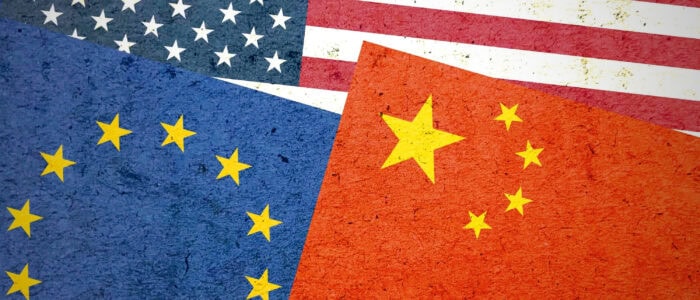
Fear of China and despair at US unreliability extending into coercion can be felt across Europe. At worst this extends to the scenario of economic destruction through systematic cheating accompanied by defencelessness against an allied Russia.
In the US a bipartisan consensus holds that manufacturing jobs were destroyed by China, and high tariffs are a necessary response. That 10 years of resulting action has not delivered any renaissance is only leading to the idea that they haven’t yet been done right.
Europe is following suit, starting similarly with protection for electric vehicles and the steel industry. That this will raise prices and render exports uncompetitive compared with China is rarely discussed.
While much outward focus remains on President Trump’s attack on trade rules, underneath that noise is technology driven openness that has changed the global economy in recent decades. This is profoundly destabilising to Europe and North America which in effect created the modern order.
Transformation is rarely a comfortable process. Sulking and taking one’s ball away because of being on the losing side is easier but never solves anything. Coercion of the weaker is likely to be similarly short-term in effectiveness, encouraging countries to go elsewhere.
Responding successfully while rebuilding domestic confidence is now the era-defining challenge for the EU and others. Unfortunately, this is also an age that demands quick and easy solutions, not a good fit to complex policy problems not least in a multi-country bloc.
Restoring a sense of intellectual enquiry to debate is crucial, content of which should include:
Accept the rise of China and others: The post-Second World War order was aimed at global prosperity, and delivered remarkable results. This reflects the hard work of the countries concerned as well as the rules put in place. Challenging the outcome does rather make it look like Europe only liked the rules when it obviously won.
Recognise the modern world: Never has it been so easy for goods, services, people and capital to move across borders, primarily due to technology. This also means the 4 billion individuals in South, South East, and East Asia that are approximately half the world’s population will be a far greater global presence not least given their opportunities for catch-up growth.
Acknowledge mutual insecurity: Openness and potential economic dependencies are particularly concerning in the aftermath of a pandemic, even one tackled globally, and many countries have issues with demographics, rising anxiety, joblessness, climate change, and powerful multinational companies. This includes China. Raising barriers may feel better, discussion will be more useful.
Be humble and stop whingeing: Europe and the US set global rules but also biased them to our interests when we could, leaving plenty of resentment on the part of others. Complaining that this is no longer possible won’t be popular or help set a basis for what is needed now.
Understand our own economies: European demand for cars and steel is shrinking not least compared to that of Asia. The single market is an asset but not powerful enough such that access to it can be weaponised, as shown by failed attempts to do so. Equally there are some great strengths in advanced manufacturing and services which benefit from the rise of other economies. Such realistic analysis should be central to today’s transition.
Public honesty will be helpful: One reason many European countries are growing slower is a choice to prioritise other objectives like welfare or extensive regulatory intervention. Such choices can also put up prices. Ageing populations are not going away. These all have consequences and pretending we can return to a previous economy painlessly is setting governments up for inevitable failure.
Set direction based on values: Europe has many policies but little vision about its future. That must change and should be based on what others value about us, the underpinning democratic stability, rule of law, and consensus-based politics. This has a priceless economic value that must be prioritised as the underpinning of general prosperity, but is clearly under threat from internal and external players.
Be realistic about others: China is not in fact going to manufacture everything better and cheaper while perfecting state subsidies and all future technologies, at the same time as undermining Europe in particular. They will however like so many others others aim to be globally competitive while avoiding dependencies in as many areas as they can, and be vulnerable to innovation elsewhere.
Don’t be naïve: Europe has been caught out by two of its own dependencies in recent years, on Russia for energy and the US for defence. Openness always comes with risks, but many can be overcome if there is a relatively strong and diverse economy. Complete economic security is not possible not least given modern communication infrastructures, so decisions must be taken on where to prioritise risk mitigation, and not all of that can be about China.
Focus on competitiveness: Given economic success is the main path to security, this requires globally competitive sectors, not ones behind barriers. This will be made more difficult for the EU by the change in the centre of economic gravity. Prioritising support for innovation more than protecting declining sectors must be part of the answer.
Beware of incumbents: One of the main reasons to support trade openness is reducing the hold of national champions over governments. Political and economic insecurity is by contrast leading to a resurgence of demands from incumbents for economically damaging protection and subsidies, and they already benefit from being able to navigate increasingly complex domestic and international regulatory landscapes. Europe badly needs to find a way genuinely encourage competition.
Revamp partnerships: EU and US trade agreements were traditionally exercises in seeking concessions from smaller countries, and both are now ignoring existing agreements in new protectionist approaches. Genuine economic security requires diverse sources of supply and demand that should be helped by strong partnerships that are less obviously transactional but should not be restricted to trying to find those with the same problems who will struggle to cooperate.
Integrate third country tools: New autonomy and security measures such as on steel should be integrated into existing EU relations to strengthen these and use administrative time more effectively. New partnership structures are thus required that should also consider a new generation of rules to manage today’s openness, such as preventing weaponisation of dependencies.
Stop waiting for global economic police: Expectations of WTO rules as hard international law enforced by a dispute settlement process were exaggerated, as is now evident. Restoring institutions is not the immediate answer given different economic times and a widespread lack of mutual trust. Wider discussion on addressing today’s challenges should instead be the foundation for finding new ways to provide predictability particularly for smaller countries and companies.
Don’t try to have all the answers now: Widespread demands for instant answers are not helping the European debate around complex geo-economic and geo-political issues. This is not least as innovation around Artificial Intelligence or deployment of new cheap energy sources means the change continues. Honesty needs to extend to not having a complete policy diagnosis.
Realistically, this has all been coming for some time and we might also reflect on a failure to plan. That China has not developed politically as we would have chosen is unsurprising, similarly that EU-US relations should be weakened by no longer being the joint hegemon. Demonstrably the EU is not a trade superpower, and must find its way in the world around the two countries that are, or retreat into protection and inevitable decline on the Argentinian model.
Beyond being upset at the loss of previous status there’s no good reason for a wealthy set of countries to step back given this remains an attractive market including for China, whose companies want the prestige of succeeding here. This is a continent with history, culture, education, and liberalism, strong in research and development, and regulated fairly. There is still just about a mixed economy in which small companies can compete with the largest, and support for individual adjustment. This should be the basis for success in an increasingly complex world.
Throwing all of this out to simplistically focus on long-gone manufacturing strengths, closure of labour markets, or fear of China would be a big mistake. Instead, there needs to be a complete rethink about the EU’s global position, far beyond the Draghi and Letta reports that still reflected an old world of European dominance. This is hardly likely to be an easy process not least alongside finding a new global equilibrium for the world’s inter-connections. What would at least be a good first step is to acknowledge the scale of the challenge, and to start to make the argument domestically that Europe’s best interests still lie in global engagement.